Have you ever pulled into your driveway after a humid Richmond summer afternoon and felt like the ground was actually trying to grab your tires? That sticky, radiating heat is the reality of living in a humid subtropical climate where your choice of paving material can feel like a high-stakes science experiment.
For Richmond property owners, the debate between concrete and asphalt is a decision that impacts your wallet, your Saturday mornings, and your home’s curb appeal for the next thirty years.
The Richmond Climate Factor: Heat vs. Humidity
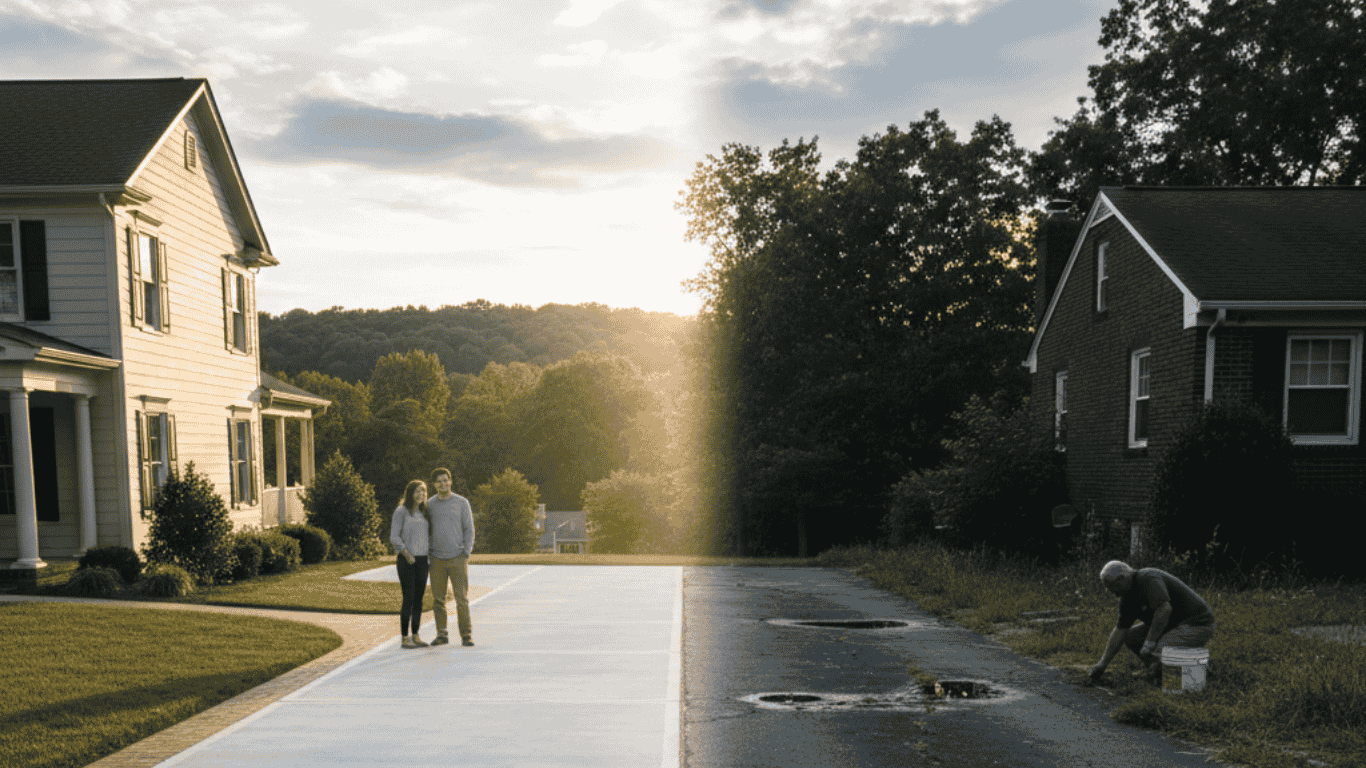
In our corner of Virginia, we experience a unique “paving purgatory” where summers are blistering, and winters are just cold enough to trigger nasty freeze-thaw cycles. Asphalt is a petroleum-based product, which means it thrives on flexibility. While this helps it survive the occasional winter frost without snapping, it becomes its own worst enemy in July. On a 95°C day in Richmond, asphalt surface temperatures can exceed 140°C, softening the binder and causing “rutting” from heavy SUVs that leave permanent indentations.
Concrete, by contrast, acts like a heat sink. It remains rigid regardless of how much the sun beats down on it. Recent climate data suggests that light-colored concrete surfaces can be up to 10°C cooler than dark asphalt, significantly reducing the “urban heat island” effect around your home. If you enjoy walking barefoot to your mailbox, your feet will certainly thank you for choosing the lighter option.
Lifespan and the True Cost of Cheap
Many homeowners lean toward asphalt because the upfront cost is appealing. According to a report, in 2026, installing a standard asphalt driveway typically costs $7-$15 per square foot, while installing concrete costs $8-$20 per square foot. However, looking at the sticker price is like buying a cheap pair of shoes that fall apart in six months.
Consider the “Service Life” reality:
- Asphalt Lifespan: 15 to 20 years (requiring resealing every 3 years).
- Concrete Lifespan: 30 to 50 years (requires almost zero structural maintenance).
A recent study on residential infrastructure found that while concrete has a 35% higher upfront cost, its lifetime maintenance costs are nearly 60% lower than those of asphalt. When you factor in the $0.35 to $0.50 per square foot you will spend on sealcoating asphalt every few years, the expensive concrete driveway actually pays for itself by the time your mortgage is halfway finished.
Maintenance: Weekend Warrior or Relaxed Homeowner?
If you choose asphalt, you are committing to a lifelong relationship with sealant. To prevent Richmond’s heavy spring rains from penetrating the surface and washing away the base, you must regularly seal the asphalt’s pores. If you skip this, water will freeze inside the cracks during a January cold snap, expanding and turning a tiny fissure into a tire-popping pothole by February.
Concrete is much more “set it and forget it.” Beyond occasional power washing to remove Virginia red clay or pollen, it requires very little maintenance. Even in aesthetics, modern techniques enable stamped patterns and stains that mimic stone or brick, something asphalt cannot replicate. This is where the expertise of professional concrete contractors in Richmond VA, becomes invaluable. They can design a reinforced slab that handles the weight of multiple vehicles without the “alligator cracking” common in neglected asphalt.
Does a New Driveway Actually Increase Home Value?
In the Richmond real estate market, first impressions are everything. Data from local appraisals indicates that a high-quality concrete driveway can provide a Return on Investment (ROI) of 50% to 80%, potentially adding $5,000 to $10,000 to your home’s resale value. Potential buyers see a concrete driveway and think durability, whereas an older asphalt driveway often signals a looming repair bill.
| Feature | Asphalt | Concrete |
| Initial Cost | Lower ($7-$15/sq. ft.) | Higher ($8-$20/sq. ft.) |
| Lifespan | 15–20 Years | 30–50 Years |
| Heat Resistance | Poor (Softens) | Excellent (Rigid) |
| Curb Appeal | Standard/Basic | High (Customizable) |
| Maintenance | High (Sealing needed) | Minimal |
Is Concrete Always the Better Choice?
While asphalt is great for long, rural country lanes where cost is the primary driver, concrete is the undisputed king for Richmond suburban homes. It handles the humidity better, stays cooler, and lasts twice as long. When you are ready to upgrade your property, working with a team that understands local soil conditions and drainage is the best way to ensure your investment stays crack-free for decades.