
Ever notice a door in your home that suddenly decides it doesn’t want to close, or a hairline fracture creeping up the basement wall like a slow-motion lightning bolt? In a city as historic as Boston, these quirks are often dismissed as old house charm. But at what point does charm turn into a structural catastrophe?
If you are wondering whether you can delay foundation repair without risk, the short answer is a resounding no. While it is tempting to push a major repair into next year’s budget, the unique geology of the Hub, from the clay-rich soils of Back Bay to the shifting water tables in the South End, makes procrastination a very expensive gamble.
The Hidden Mathematics of Delay
Many homeowners view foundation issues as a static problem. They assume a crack today will be the same crack in six months, but the engineering reality is much more volatile.
In 2026, data suggest that the average cost for minor foundation interventions in Massachusetts ranges from $3,500 to $5,700. However, if that same issue is left unaddressed until it compromises the load-bearing walls, homeowners often face invoices exceeding $15,000 to $20,000. You are paying for the “interest” accumulated through structural neglect.
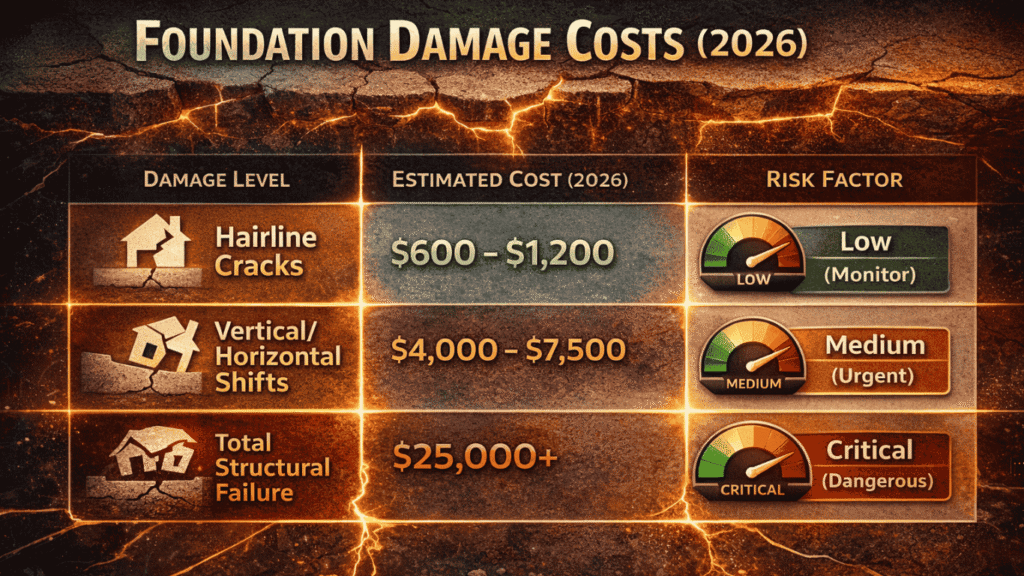
Why Boston’s Climate is Your Foundation’s Worst Enemy
Boston has a cycle of geological torture, as the freeze-thaw cycle is particularly brutal here. When water enters a small fissure in your foundation and freezes, it expands with enough force to shatter solid concrete.
What happens if you ignore these signs?
- The Domino Effect: A shifting foundation can cause drywall to snap, windows to lose their seals, and even roofing trusses to pull apart. It is called the Domino Effect.
- Moisture and Mold: In our humid Atlantic climate, a cracked foundation is an open invitation for groundwater intrusion, leading to toxic mold growth, which can cost more to remediate than the foundation repair itself.
- Plumbing Nightmares: As your house settles unevenly, your rigid plumbing pipes are subjected to significant shear stress. A snapped sewer line under your slab is a mess no amount of scented candles can fix.
How Much Does Foundation Damage Devalue a Boston Home?
If you are planning to sell your property, a compromised foundation is a major red flag for traditional buyers. Most mortgage lenders will not even approve a loan for a house with documented structural instability.
In the current Massachusetts real estate market, a home with known foundation issues typically receives a 10% to 15% price reduction below market value. For an $800,000 triple-decker in Dorchester, that is a $120,000 loss just for avoiding a $5,000 repair.
When you decide to restore your home’s health, choosing the right expertise is vital. You need someone who understands the specific masonry traditions of New England. For many residents, Boston Masonry Contractors has become the gold standard for Foundation Repair in Boston, offering the precision that only decades of experience with local soil conditions can provide. Their team addresses the hydrostatic pressure and soil stabilization issues that caused the problem.
Is Every Crack a Crisis?
How do you know if you are overreacting? While hairline cracks (less than 1/16 inch) are often cosmetic, you should look for the Warning Trio.
- Stair-step cracks in exterior brickwork.
- Horizontal cracks along the foundation line (this indicates soil pressure).
- Nail pops and gaps between the ceiling and walls.
If you spot any of these, the “wait and see” approach is no longer an option. So, what are you waiting for? Take action today to preserve your safety, your sanity, and your bank account.